
Deo Tibba Expedition — 6,001m
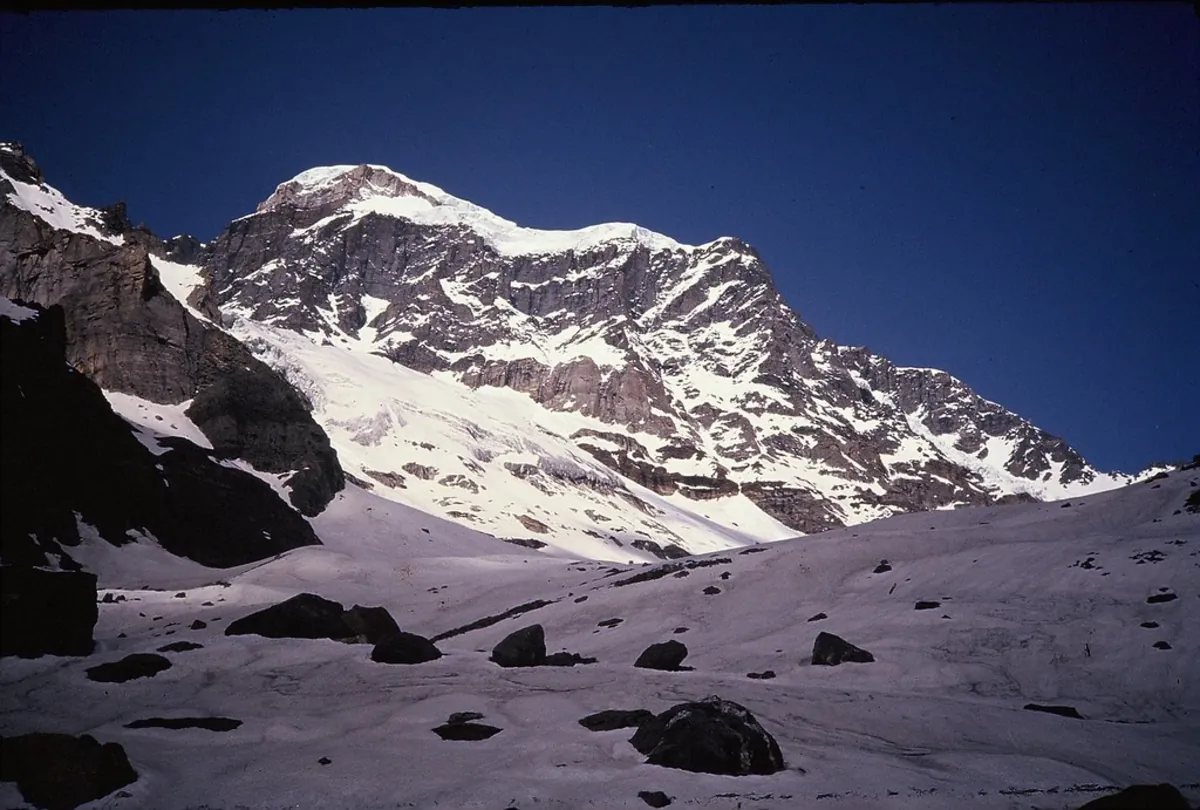
Deo Tibba Expedition — 6,001m | 14 Days
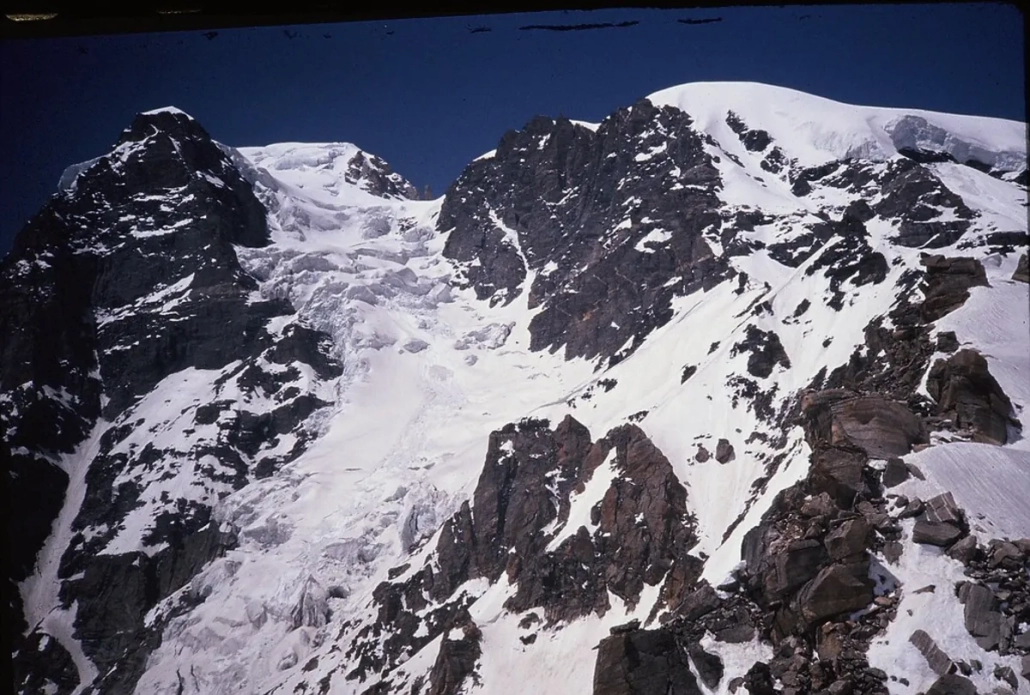
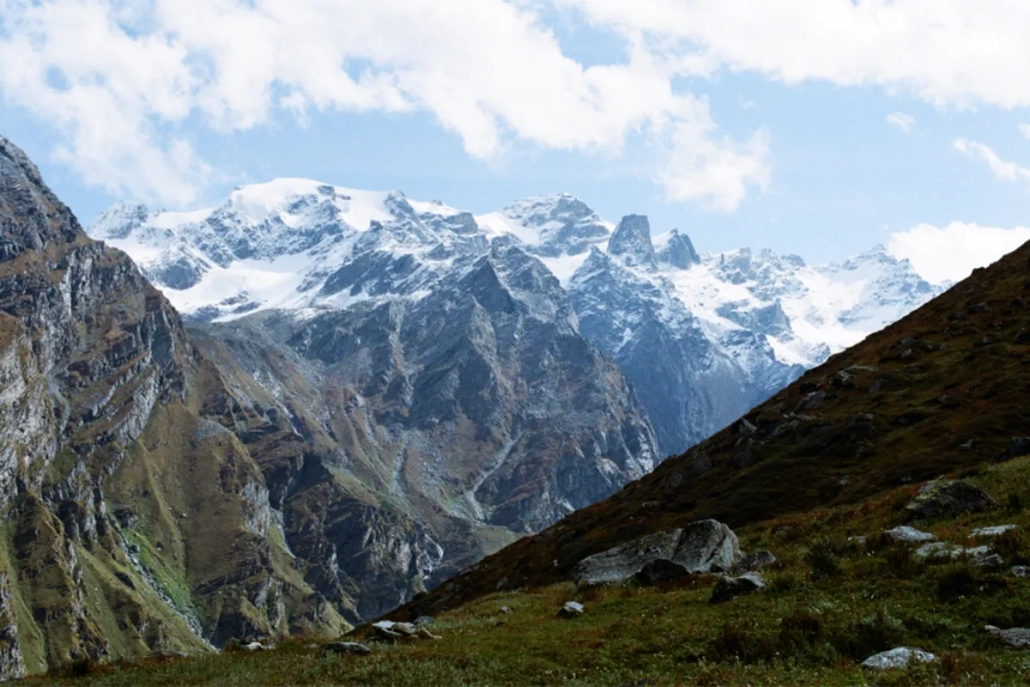
Deo Tibba is the second-highest peak in the Pir Panjal range of Himachal Pradesh, standing at exactly 6,001 metres above the Kullu Valley east of Manali. It is not a mountain that rewards casual ambition. The route is technically demanding, the weather temperamental, and the summit — a broad snow dome rather than a sharp point — is reached by two ice gullies and a high glacial traverse that require full mountaineering competence. But for those with the preparation and the patience to give Deo Tibba what it demands, the summit delivers: a 360° panorama of the peaks of Kullu and Lahaul, with Indrasan (6,221m) rising immediately beside you and the Great Himalaya range spread across the full eastern horizon.
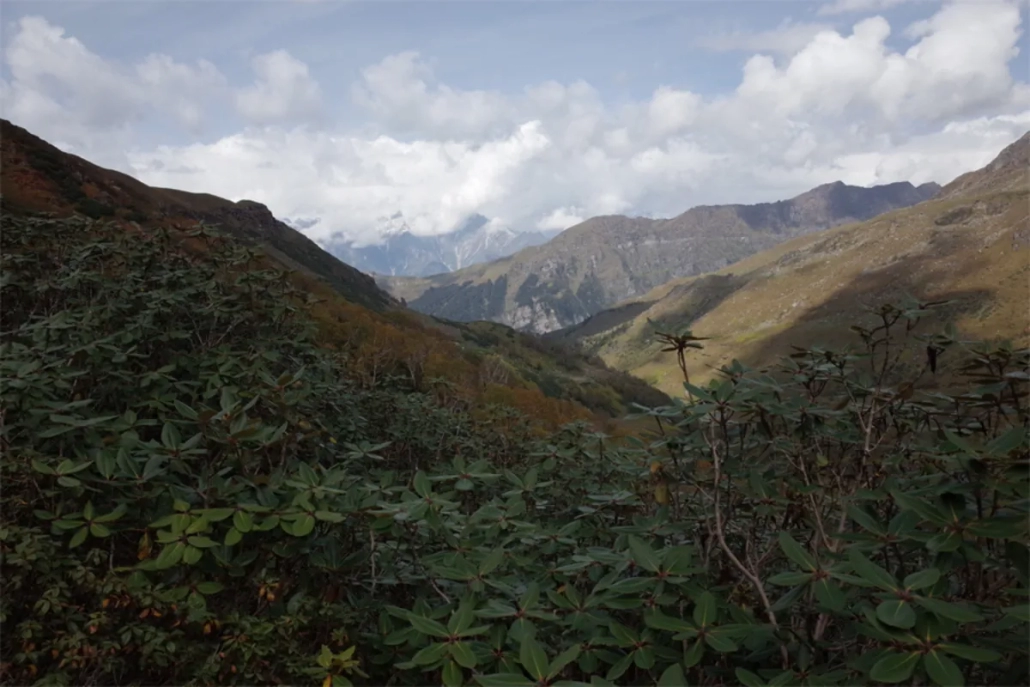
The approach itself is one of the finest in Himachal Pradesh. The route climbs from Jagatsukh — an ancient village of carved wooden houses that was once the old capital of the Kullu kingdom — through oak and deodar forest, past the alpine grasslands of Seri, to the base camp at Tenta beside the glacially carved lake of Chota Chandratal. The base camp sits directly beneath Deo Tibba’s south face and provides an unobstructed view of the Duhangan Col gully — the crux of the technical section that separates the approach from the high mountain.
The Alpine grade of Deo Tibba is PD (Peu Difficile) — technically above a straight walk-up, below a Grade D or TD objective. The Duhangan Col gully is approximately 55 degrees at its steepest and requires fixed rope installation. Above the col, a glacier traverse and the Piton Ridge gully lead to the summit dome. This is an expedition recommended for climbers with at least two completed Himalayan treks above 4,500m and prior experience with crampons, ice axe arrest, and fixed rope ascent. No previous 6,000m summit experience is required — but discipline, physical conditioning, and the willingness to follow your guide’s judgment on the mountain are.
Summit Routes operates this expedition with local Himachali mountain staff. We employ guides and high-altitude crew from the Kullu and Manali region — people who know this mountain’s particular moods through seasons of experience, not a single ascent.
Important Notes
- Best Season: May to June (pre-monsoon) and September to October (post-monsoon). June is preferred for longer snow consolidation on the upper gullies.
- Alpine Grade: PD (Peu Difficile) — requires technical mountaineering equipment and competence.
- Summit Height: 6,001m. Highest camp: Summit Camp at 5,500m.
- Technical Requirements: Crampons, ice axe, harness, ascenders, and fixed rope technique required. Full technical climbing gear provided by Summit Routes.
- Prerequisite Experience: Minimum two multi-day treks above 4,500m. Prior crampon and ice axe experience strongly recommended. An easy 6,000m summit (e.g. Friendship Peak, Stok Kangri) as prior experience is ideal but not mandatory for technically confident candidates.
- IMF Permit: Deo Tibba requires an Indian Mountaineering Foundation (IMF) peak permit — arranged in full by Summit Routes.
- Fitness Standard: Should be able to run 6km in under 30 minutes or walk 10km continuously without distress. If this is your first high-altitude expedition, we strongly recommend reading our guide to altitude sickness in the Himalaya before departure.
Brief Itinerary
| Day 1 | Arrive Manali (1,950m) — Hotel, Briefing, Gear Check |
| Day 2 | Acclimatisation in Manali — Permit Documentation |
| Day 3 | Drive Manali to Khanol (2,700m) — Trek to Chikka (3,215m) |
| Day 4 | Trek Chikka to Seri (3,935m) |
| Day 5 | Trek Seri to Tenta Base Camp (4,150m) — Visit Chota Chandratal (4,480m) |
| Day 6 | Rest & Acclimatisation at Base Camp — Technical Skills Practice |
| Day 7 | Base Camp to Duhangan Col — Establish Camp 1 (5,150m) |
| Day 8 | Load Ferry: Camp 1 to Summit Camp (5,500m) — Return to Camp 1 |
| Day 9 | Camp 1 to Summit Camp (5,500m) |
| Day 10 | Summit Push — Deo Tibba (6,001m) — Descend to Camp 1 (5,150m) |
| Day 11 | Camp 1 to Base Camp (4,150m) |
| Day 12 | Base Camp to Chikka (3,215m) |
| Day 13 | Trek Chikka to Khanol — Drive to Manali |
| Day 14 | Departure from Manali |
Altitude Profile
Deo Tibba Expedition Itinerary — 6,001m | 14 Days (Manali to Manali)
Pir Panjal Range, Himachal Pradesh — via Jagatsukh–Duhangan Valley
Day 1: Arrive Manali (1,950m) — Hotel, Briefing, Gear Check
- Arrive in Manali from Delhi or Chandigarh by road or from Bhuntar by air (nearest airport: Kullu-Manali / Bhuntar, ~50km south of Manali).
- Check in to hotel. Full expedition briefing with your Summit Routes lead guide: route overview, weather patterns, technical section briefing, team roles, and emergency protocols.
- Gear check and distribution: expedition-issue technical gear (crampons, ice axe, harness, ascenders, helmet) fitted and adjusted for each team member.
- IMF peak permit documentation reviewed. Porters and horsemen briefed for Day 3 departure.
- Evening: explore Manali's Old Town and Hadimba Devi Temple — built in 1553 and set in a cedar forest a short walk from the town centre.
- Overnight: Hotel in Manali | Meals: Dinner
Day 2: Acclimatisation in Manali — Permit Documentation
- Full rest day at 1,950m before the climb begins. Do not attempt any significant altitude gain today.
- IMF permit formalities completed with local government offices. This is standard procedure for all regulated peak expeditions in Himachal Pradesh.
- Final load sorting: all personal bags above 15kg handed to horses for the approach; summit-day packs prepared separately.
- Review our altitude sickness guide — the physiology of altitude becomes directly relevant from tomorrow.
- Optional acclimatisation walk to Vashist village and its hot springs (1,990m) — same elevation, excellent way to spend an afternoon before an expedition.
- Overnight: Hotel in Manali | Meals: Breakfast, Dinner
Day 3: Drive Manali to Khanol (2,700m) — Trek to Chikka (3,215m)
Drive: ~15 km | 1–1.5 hours • Trek: ~5 km | 2–3 hours
- Drive south along the Beas River to Jagatsukh — once the old capital of the Kullu kingdom, a compact village of carved timber-framed houses with temples dating back several centuries. Continue by vehicle past the Allain Duhangan hydroelectric project to the road terminus at Khanol (2,700m).
- Trek begins at Khanol. The trail follows the right bank of the Duhangan Nala stream through thinning forest to the campsite at Chikka.
- Chikka (3,215m) is a traditional shepherd settlement. First clear views of Deo Tibba's southern face appear from the meadow above the camp, alongside the flanks of Indrasan (6,221m) and Jagatsukh Peak (5,050m).
- Overnight: Camp at Chikka | Meals: Breakfast, Lunch, Dinner
Day 4: Trek Chikka to Seri (3,935m)
Trek Distance: ~10 km | 6–7 hours
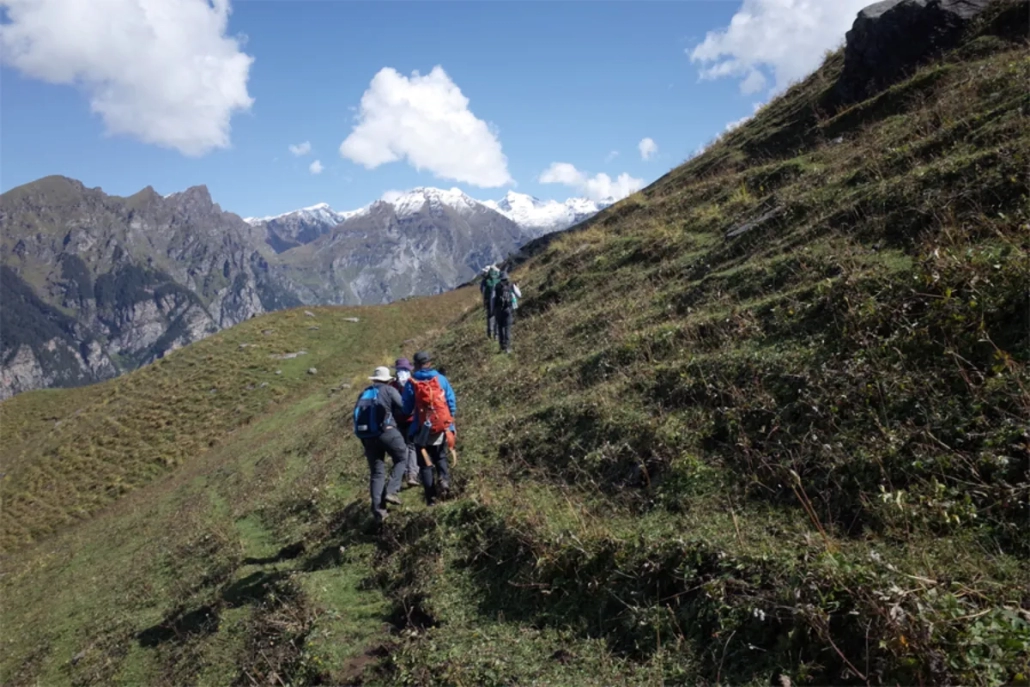
- The trail climbs steadily through birch forest as the tree cover thins. Pass through the scattered boulders of Panduropa and a freshwater spring at Dudu Patthar before the trail enters the broad high-altitude grasslands of Seri.
- Seri (3,935m) is a former glaciated lakebed — wide, green in summer, ringed by cliffs and hanging glaciers. The dome of Deo Tibba looms to the north.
- Overnight: Camp at Seri | Meals: Breakfast, Lunch, Dinner
Day 5: Trek Seri to Tenta Base Camp (4,150m) — Visit Chota Chandratal (4,480m)
Trek Distance: ~9 km return including lake visit | 5–6 hours
- A stream crossing in the early morning leads to the boulder and moraine terrain of the upper valley. The trail climbs through rock and glacial debris to Tenta Base Camp (4,150m).
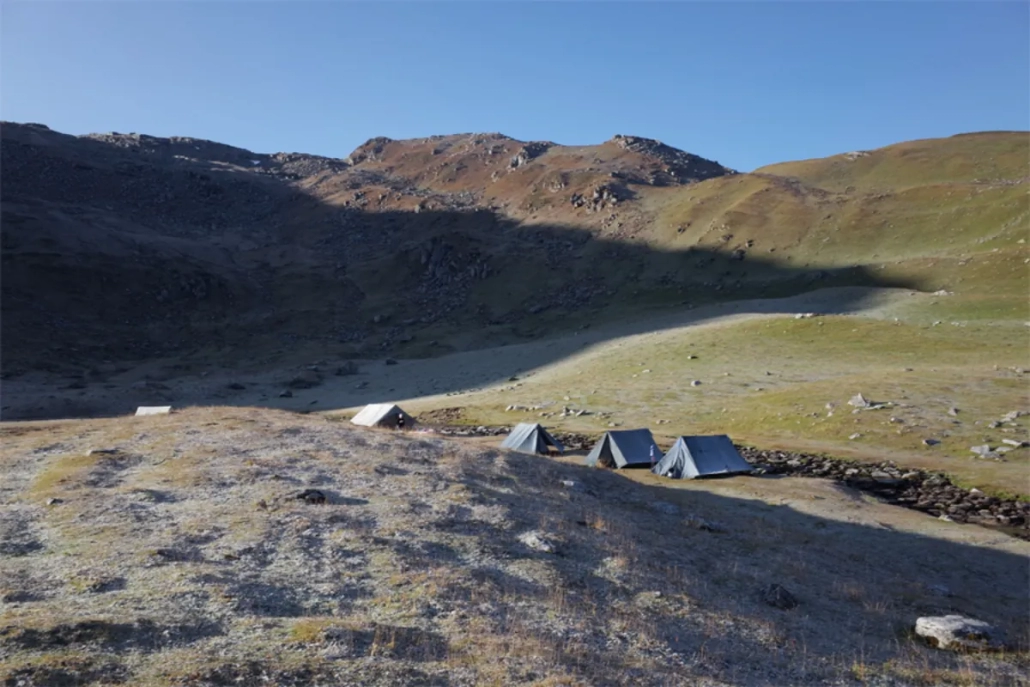
- Tenta is surrounded on three sides by hanging glaciers and cliffs. Deo Tibba's summit dome is directly opposite from camp — the Duhangan Col gully clearly visible. This is a campsite that demands you look up.
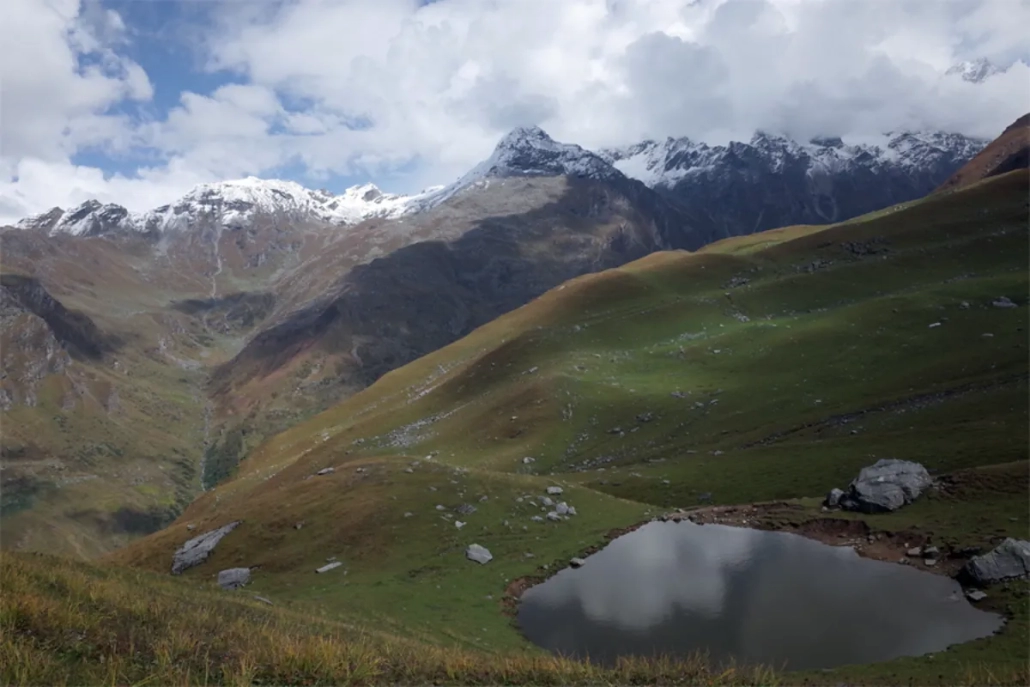
- After establishing camp, continue to Chota Chandratal (4,480m) — the glacial lake at the foot of the Deo Tibba glacier, a deep emerald blue fed by glacial meltwater. The highest point reached without technical equipment on the expedition.
- Overnight: Tenta Base Camp (4,150m) | Meals: Breakfast, Lunch, Dinner
Day 6: Rest & Acclimatisation at Base Camp — Technical Skills Practice
- Mandatory rest day at 4,150m before entering the high-altitude technical zone.
- Morning technical session: crampons fitted on boots, harness adjusted, ice axe technique and self-arrest practiced, ascender technique on fixed rope. Each climber assessed by the lead guide before moving higher.
- Afternoon: rest, hydration, equipment maintenance. Weather review with the guide — the pattern of the next two days is critical for summit planning.
- Overnight: Base Camp | Meals: Breakfast, Lunch, Dinner
Day 7: Base Camp to Duhangan Col — Establish Camp 1 (5,150m)
Altitude gain: ~1,000m | 6–8 hours
- The most technically committed day of the approach. From Tenta, the route crosses the glacier moraine and enters the base of the Duhangan Col gully — the single most demanding section of the expedition.
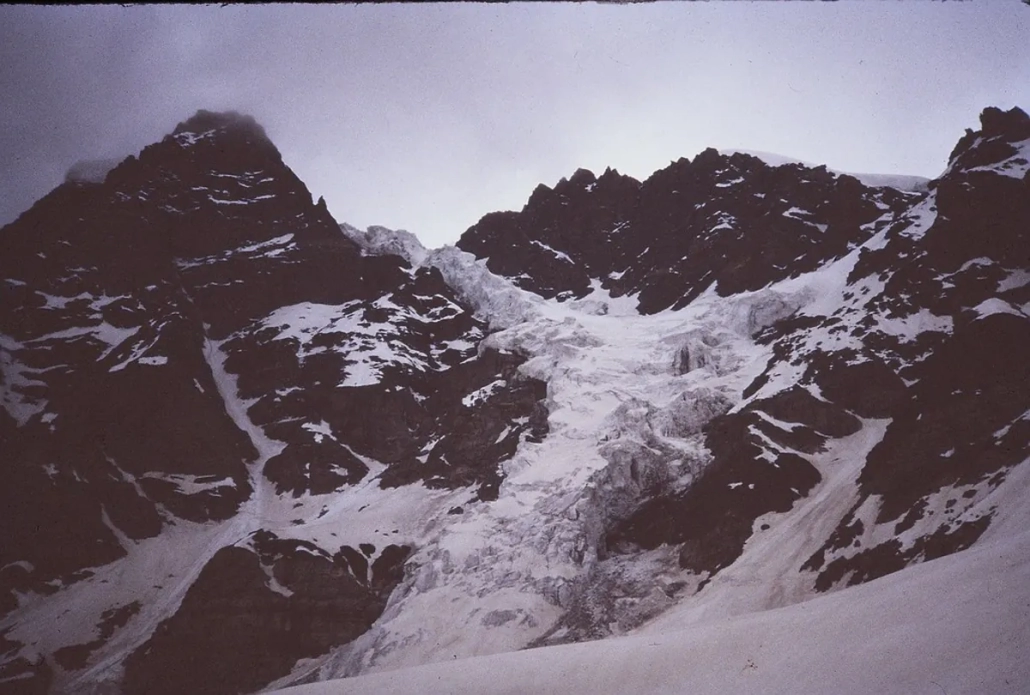
- The Duhangan Col gully is approximately 55° at its steepest. Fixed ropes are installed by the lead guide before the team follows on ascenders. The gully is consistently steep for 300–400 vertical metres, with sections of hard water ice in early season. This is where the expedition earns its PD rating.
- At the col, the angle eases. The glacier above is wide and open, with Deo Tibba's summit dome visible ahead and the Indrasan massif to the east. Camp 1 established at 5,150m on a flat section of the glacier.
- Overnight: Camp 1 (5,150m) | Meals: Breakfast, Lunch, Dinner
Day 8: Load Ferry — Camp 1 to Summit Camp (5,500m) — Return to Camp 1
Distance: ~3 km return | 5–6 hours
- A load-carry day — supplies moved to Summit Camp at 5,500m, deposited, and the team descends back to Camp 1 to sleep. The body adapts to 5,500m by visiting it and descending, rather than sleeping at altitude before it is ready.
- On descent, assess the Piton Ridge gully from below. The guide identifies conditions and confirms the summit-day route and turnaround timing.
- Overnight: Camp 1 (5,150m) | Meals: Breakfast, Lunch, Dinner
Day 9: Camp 1 to Summit Camp (5,500m)
Distance: ~3 km | 3–4 hours
- Move to Summit Camp with personal overnight gear. Short distance allows a relaxed morning and full afternoon rest before the 2am start the following day.
- Arrive by early afternoon. Set up tents, eat well, hydrate aggressively, sleep by 6–7pm. Guide briefing on summit-day timeline in the early evening: departure time, route decision, turnaround time, emergency descent protocol.
- Weather is the decisive factor at this stage. If conditions are not suitable on Day 10, the team holds at Summit Camp for one additional day — this is the purpose of buffer days in the programme.
- Overnight: Summit Camp (5,500m) | Meals: Breakfast, Lunch, Dinner
Day 10: Summit Push — Deo Tibba (6,001m) — Return to Camp 1 (5,150m)
Summit day distance: ~4 km return | 8–10 hours
- Alpine start at 2:00am. Headtorches on, crampons tight, ice axes in hand. The pre-dawn start is mandatory — the upper gullies harden overnight and provide secure footing; the same snow softens dangerously after the sun reaches it. The summit must be reached and descent begun before 11am.
- The Piton Ridge gully is the final technical obstacle — fixed ropes installed, requiring the same focused ascent technique as the Duhangan Col. Above the gully, the angle eases onto the summit ridge and the dome comes into view.
- The Deo Tibba summit at 6,001m is a broad snow dome. Indrasan (6,221m) rises immediately to the northeast. The peaks of Lahaul and the Kullu valley floor 4,000 metres below fill the panorama.
- Summit photographs and rest. Begin descent no later than the turnaround time set by your guide — regardless of how the summit feels.
- Descend via Summit Camp to Camp 1. Full descent by mid-afternoon.
- Overnight: Camp 1 (5,150m) | Meals: Breakfast, Lunch, Dinner
Day 11: Camp 1 to Base Camp (4,150m)
- Strike Camp 1. Full descent to Tenta Base Camp via the Duhangan Col gully — fixed ropes used for descent as on ascent. The downclimb requires equal concentration to the ascent.
- Arrive base camp by midday. Full hot meal, the return of porters to collect equipment.
- Overnight: Base Camp at Tenta (4,150m) | Meals: Breakfast, Lunch, Dinner
Day 12: Base Camp to Chikka (3,215m)
Trek Distance: ~9 km | 5–6 hours
- Full strike of base camp. The return via Seri and the Duhangan valley is faster going down and carries a different quality of attention — the expedition is behind you now. Arrive Chikka by afternoon.
- Overnight: Camp at Chikka | Meals: Breakfast, Lunch, Dinner
Day 13: Trek Chikka to Khanol — Drive to Manali
Trek: ~5 km | 2–3 hours • Drive: ~1.5 hours
- Final morning on the trail. Descend through the forest to Khanol road head. Drive back through Jagatsukh village and into Manali.
- Hotel check-in, hot shower, expedition dinner with the full team and crew.
- Overnight: Hotel in Manali | Meals: Breakfast, Dinner
Day 14: Departure from Manali
- Transfer to Bhuntar Airport (50km) for onward flight, or road transfer to Chandigarh (~5–6 hours) or Delhi (~12–14 hours).
- Meals: Breakfast
IN-14 – Deo Tibba Expedition 6,001m (14 Days)
Starting from USD 1,750 per person
(Based on 2 climbers, certified lead guide, support crew, and full technical equipment)
👉 Request Custom Itinerary & QuoteFully supported summit expedition — all climbing equipment, camps, meals, IMF permit, and technical crew included from Manali to Manali. No hidden costs.
Comparing Indian Himalayan summit options? See how Deo Tibba compares to our Kang Yatse II Expedition in Ladakh.
Budgeting for your first Himalayan expedition? Our cost guide explains what goes into expedition pricing and what to plan for.
INCLUDED
- All ground transport: Manali–Khanol (Day 3) and Khanol–Manali (Day 13)
- 2 nights hotel accommodation in Manali (Days 1–2 and Day 13)
- 10 nights full camping accommodation on approach and mountain
- All meals throughout the programme: hotel breakfasts in Manali and all meals on trek and expedition from Day 3 to Day 13
- IMF (Indian Mountaineering Foundation) peak permit for Deo Tibba
- Certified English-speaking lead mountain guide with Deo Tibba summit experience
- High-altitude support staff: cook, camp crew, and horsemen for approach
- Full technical climbing equipment per person: crampons, ice axe, climbing harness, ascender, locking carabiners, helmet, and gaiters
- Expedition rope: fixed line installation on Duhangan Col gully and Piton Ridge gully by lead guide
- High-altitude tents: 4-season expedition tents at Camp 1 and Summit Camp (twin sharing)
- Sleeping bags rated to -20°C for high camps
- Camping equipment for approach: dome tents, kitchen tent, dining tent, toilet tent
- First-aid kit, pulse oximeter, and supplemental oxygen cylinder at base camp
- Summit Routes expedition duffel bag
NOT INCLUDED
- International or domestic flights to/from Bhuntar or Chandigarh
- Hotel nights in Manali beyond the 2 included nights (pre/post expedition extensions available on request)
- Travel and expedition insurance — mandatory; must cover high altitude above 6,500m and helicopter evacuation
- Personal high-altitude clothing: down suit, insulated gloves, goggles, balaclava, thermal layers (available to rent in Manali on request)
- Personal trekking boots — must be compatible with step-in crampons (B2/B3 boot sole rating); rental available in Manali on request
- Beverages, snacks, and personal expenses
- Tips for guide, cook, and support crew (customary and appreciated)
- Anything not specified in the Included list
Accommodation — Deo Tibba Expedition
Manali — Days 1, 2 & 13
Accommodation in Manali is arranged at The Himalayan or a similar 3-star standard hotel in a central location. Rooms are on a twin-sharing basis with attached bathroom, hot shower, electricity, and Wi-Fi. These nights provide time for the expedition briefing, gear checks, permit formalities, and on return, a well-earned hot shower and the expedition celebration dinner.
Approach Camps — Days 3–5 & Days 11–12
All nights under canvas — Summit Routes 2-person dome tents with sleeping mats. Kitchen tent, dining tent, and toilet tent at every campsite.
- Chikka (Day 3 & Day 12): Flat meadow with a small temple. Clean water from the Duhangan Nala. Sheltered from wind by the forest treeline. Cold nights from here — sleeping bag recommended to at least -5°C.
- Seri (Day 4): Open plateau campsite. Exposed to afternoon wind — tent pegging important. Clear views north to Deo Tibba's face. Cold nights from here onward even in summer.
- Tenta Base Camp (Days 5, 6 & 11): The best campsite on the expedition — flat glacier-polished ground, direct views of Deo Tibba's south face, clean water from snowmelt streams. Sleeping bags rated to -10°C minimum required here. The Duhangan Col gully is visible from the dining tent.
High Camps — Days 7–10
- Camp 1 — 5,150m (Days 7, 8 & 10): 4-season expedition tents provided, sleeping bags rated to -20°C. Snow platform cut by guides. Stove and hot drinks prepared inside tent. Wind can be significant at the col — tent anchoring is thorough.
- Summit Camp — 5,500m (Day 9): Same 4-season specification. Lightweight high-altitude rations pre-loaded on the ferry day. Maximum one night here before the summit push. Conditions at this altitude are serious — the tent is for rest, not comfort.
Notes on High-Altitude Sleeping
- Sleeping bags rated to -20°C are provided for Camp 1 and Summit Camp. A personal sleeping bag liner is recommended for additional warmth and hygiene.
- Above base camp, all water is from snowmelt. Your guide carries water purification tablets. Do not drink unfiltered meltwater at altitude.
- On summit day, each climber carries their own thermos from Summit Camp. Hot tea and soup are prepared before the 2am departure. There is no resupply until return to camp.
- Pre-monsoon season (May–June): expect the possibility of fresh snow on the approach from Day 4 upward. Post-monsoon season (Sep–Oct): colder and drier — excellent summit conditions but colder sleeping at high camp.
What to Pack — Deo Tibba Expedition
Deo Tibba sits at 6,001m in the Pir Panjal range of Himachal Pradesh — a pre- or post-monsoon expedition with two very distinct climate zones. The Manali approach is warm and green at 1,950m; by Tenta Base Camp (4,150m) temperatures drop significantly overnight even in May and June. Summit Camp at 5,500m and summit day itself require full winter mountain gear regardless of season. Pre-monsoon departures face potential wet weather on the lower approach; post-monsoon brings cold, clear, stable conditions — but colder sleeping temperatures at the high camps. Pack for both.
Technical climbing equipment — crampons, ice axe, harness, ascenders, locking carabiners, helmet, gaiters, 4-season tents, and expedition sleeping bags (-20°C) for high camps — is provided by Summit Routes. Personal mountaineering boots are your responsibility, and boot/crampon compatibility is the most common equipment issue on this expedition. Everything below is personal gear.
Clothing & Layers
- Insulated down jacket rated to -15°C or colder — for summit day, high camp evenings, and cold nights at Seri and Base Camp. Non-negotiable. The temperature differential between Manali and 6,001m is extreme.
- Insulating fleece mid-layer × 2
- Moisture-wicking base layers (top and bottom) × 3 — merino wool preferred; on a 14-day expedition without laundry, odour management and moisture control matter more than on a short trek.
- Waterproof hardshell jacket (Gore-Tex or equivalent) — essential for pre-monsoon departures where afternoon rain and summit-day wind are both likely. Post-monsoon trips need it primarily for summit wind.
- Waterproof over-trousers — for the Duhangan Col gully ascent, summit day conditions, and wet lower approach in pre-monsoon season.
- Trekking trousers × 2 — lightweight and fast-drying for the Jagatsukh forest approach and Seri meadow days.
- Thermal leggings × 2 — for cold nights at Seri, Tenta, and all high camps.
- Balaclava — mandatory for the 2am summit departure. Wind at the Duhangan Col and Piton Ridge gully is severe.
- Warm hat and sun hat or wide-brimmed cap — UV at 5,000m+ in Himachal is intense even through cloud. A sun hat on the lower approach is as important as a warm hat above camp.
- Insulated gloves — a lightweight liner pair for ascender work and a heavy insulated outer pair for the summit. Bare skin on metal hardware at -15°C causes rapid frostbite.
- Trekking socks × 4–5 pairs — heavyweight wool for the approach and high camps.
- Camp shoes or sandals — give your feet a complete break from boots at base camp evenings.
Footwear
- Mountaineering boots compatible with step-in crampons (B2 or B3 sole rating) — this is the single most critical gear decision for the entire expedition. Standard trekking boots cannot safely accept technical crampons on the 55° Duhangan Col gully or the Piton Ridge. If you are unsure of your boot's crampon compatibility, contact us before travel — compatible boots are available to rent in Manali on request. Boots must be fully broken in before arrival in Manali; new boots cause blisters on Day 3 and serious frostbite risk above 5,000m.
- Crampons — provided by Summit Routes. Fitted to your boots at Base Camp on Day 6 during the technical training session.
- Trekking poles × 2 — recommended for the Duhangan valley approach days (Days 3–5) and the long return descent (Days 11–12). Two poles on the steep descent from Base Camp is significantly easier on knees.
- Gaiters — provided by Summit Routes. Essential for glacier travel and the Duhangan Col gully in both seasons.
Personal Health & Safety
- Altitude medication — consult your doctor about Diamox before departure. The itinerary climbs from 1,950m to 4,150m between Days 1–5, then ascends to 5,150m and 5,500m over Days 7–9. The acclimatisation schedule is deliberately paced but individual responses vary significantly above 4,000m.
- Personal first aid kit — blister plasters, ibuprofen, paracetamol, antihistamines, rehydration sachets, anti-diarrhoeal tablets. Manali has pharmacies; the Duhangan valley and all camps above Chikka do not.
- Glacier sunglasses or goggles — Category 4 UV protection — non-negotiable on the Deo Tibba glacier from Day 7 onward. Standard sunglasses (Category 2–3) are insufficient on hard snow and ice at altitude; snow blindness can develop within one hour of exposure on an open glacier without appropriate protection. Wrap-around frames are preferable to straight-arm frames.
- High-SPF sunscreen (50+) — applied to all exposed skin including under the chin and inside the nostrils (reflected UV from snow). Carry enough for the full 14 days; resupply is not available on the route above Manali.
- Lip balm with SPF — cold, dry high-altitude air combined with UV causes severe lip damage within hours at the high camps.
- Hand sanitiser and wet wipes — water at high camp is limited to snowmelt, and hand hygiene before meals matters at altitude when the body's immune response is already under stress.
- Personal prescription medicines — carry at least double the required quantity.
Gear & Equipment
- Sleeping bag liner — Summit Routes provides -20°C sleeping bags for Camp 1 and Summit Camp. A liner adds warmth and keeps your bag clean across 14 days. Bring your own liner for the approach camp bags as well.
- Personal sleeping bag for approach camps — if you have one rated to at least -10°C, bring it. Tenta Base Camp (4,150m) gets cold overnight in both pre- and post-monsoon season. If you don't have one, our approach camp bags are sufficient but a personal bag of your own gives better control over warmth.
- Trekking daypack (40–55L) — carries your personal summit-day essentials and daily kit on approach days. Horses carry the main duffel on Days 3–5 and 11–12.
- Main duffel bag (60–70L, soft-sided, no hard frame) — for horse loading on the Duhangan valley approach.
- Dry bag or waterproof pack cover — important for pre-monsoon departures where afternoon rain on the lower approach is common. Also useful on the glacier where condensation and snowmelt are constant.
- Headlamp + spare batteries — the 2am summit departure makes this mission-critical. Cold at altitude depletes batteries fast; use lithium cells and keep spare batteries inside your sleeping bag overnight before summit day.
- Insulated water bottles × 2 (1L each) — standard bottles freeze before dawn at Summit Camp. Vacuum-flask or insulated Nalgene style essential for summit day. Fill and keep inside sleeping bag the night before departure.
- Water purification tablets — backup for stream and snowmelt water above Base Camp.
- Power bank — there is no electricity from Day 3 to Day 13. Solar charging is possible at Tenta Base Camp in clear conditions (better in post-monsoon season) but is not reliable above that.
Documents & Money
- Passport — valid 6+ months beyond your travel date.
- IMF permit documentation — Summit Routes arranges all permits; carry copies throughout the expedition.
- Travel insurance documents — must cover mountaineering above 6,500m and helicopter emergency evacuation. Mandatory. Verify this specifically with your insurer before you travel.
- Cash in Indian Rupees — ATMs available in Manali. There are none between Manali and the mountain. Withdraw enough in Manali on Days 1–2 to cover all personal expenses for the remaining 12 days.
Optional but Useful
- Camera with spare batteries — cold depletes batteries fast on summit day; keep spares warm against your body overnight before summit day.
- Lightweight down trousers — particularly useful at Summit Camp evenings and on the descent after the summit push when fatigue is high and body temperature drops.
- High-energy trail snacks — energy bars, nuts, chocolate, electrolyte tablets. Carry enough for 14 days; nothing is available between Manali and the mountain.
- Buff or neck gaiter × 2 — for dust on the lower approach valley and wind on the upper glacier.
- Small padlock for your duffel in Manali hotel.
- Pre-monsoon season: a lightweight waterproof pack cover and waterproof stuff sack for sleeping bag — afternoon rain on the lower approach is common in May and early June.
For a complete Himalayan packing guide with brand recommendations and a printable checklist, see our Himalayan Trekking Gear List →
Boot and crampon compatibility is the most common equipment issue on this expedition. If you're unsure whether your boots accept step-in crampons, contact us before you travel — compatible boots are available to rent in Manali and we can advise based on your specific footwear.
Safety & Emergency Protocols — Deo Tibba (6,001m) Expedition
Your safety is the absolute priority on every Summit Routes expedition. Deo Tibba is an IMF-regulated alpine peak with genuine technical terrain — a 55° ice gully, glacier travel, crevasse zones, and sustained effort above 5,000m for four consecutive days. Below is a full account of the safety protocols, emergency procedures, and equipment standards maintained on every departure.
First Aid & Medical Equipment
- Comprehensive expedition first aid kit carried by the lead guide at all times from Day 3 onward
- Emergency supplemental oxygen cylinder (2 × 4-litre bottles) at Base Camp and carried to Camp 1 for access on summit day
- Pulse oximeter for daily blood-oxygen monitoring from Day 2 in Manali — altitude awareness begins before the mountain
- Gamow hyperbaric bag available at Tenta Base Camp for severe AMS management
- Basic medications including Diamox, Dexamethasone, Nifedipine, analgesics, and blister and wound care supplies
- Daily health check-ins with guides at every campsite
Rockfall & Objective Hazard — Deo Tibba Specific
Deo Tibba's Duhangan Col gully involves loose scree and rock in the lower section and hard ice higher up. Specific precautions our guides maintain on every ascent:
- The loose scree section below the gully is always climbed before 8am when the rock is cold and stable — afternoon sun dislodges material
- Helmets are worn by every team member from the base of the gully through to the col and at all times above Camp 1
- The team moves in disciplined single file through the gully — no bunching, no overtaking
- Rest stops are taken only at confirmed safe positions off the fall line
- The guide assesses gully ice conditions before each ascent. If conditions are unstable — ice runoff, rockfall debris on the fixed line — the ascent is postponed until conditions improve
- The Piton Ridge gully on summit day carries the same protocol
Evacuation Procedure
- Primary evacuation route: assisted descent from Summit Camp or Camp 1 to Tenta Base Camp (approximately 4–6 hours), then to Chikka and Khanol road head (further 5–7 hours on foot or by horse)
- Khanol road head is accessible by vehicle — ground evacuation to Manali and Regional Hospital Manali typically takes 3–4 hours from Khanol
- For severe cases: helicopter rescue coordination through HRTC Emergency Services and the Indian Army (Manali Cantonment)
- Helicopter landing zones are pre-identified at Seri meadow (3,935m) and the Tenta Base Camp area — the flat glacier-polished ground at Tenta provides a workable landing zone in suitable wind conditions
- All evacuations are authorised and activated by the lead expedition guide — this decision cannot be overridden by the client
Guide Training & Certifications
- All expedition leaders hold an IMF Mountaineering certificate or equivalent recognised by the Tourism Department of Himachal Pradesh
- Wilderness First Responder (WFR) training or equivalent high-altitude medical certification
- Minimum of three prior Deo Tibba summit completions required for every lead guide — including at least one ascent in each season window (pre- and post-monsoon)
- Trained in fixed rope installation and management, crevasse awareness, self-arrest technique, and assisted descent on technical terrain
- Guides assess weather patterns continuously from Base Camp forward and carry the authority to postpone or abort the summit push at any stage
- Fluent English communication with clients; Hindi and Kullu dialect coordination with local crew and authorities
Travel Insurance — Mandatory Requirement
Valid travel insurance is a non-negotiable condition of participation on this expedition.
- Must cover high-altitude mountaineering to at least 6,500 metres
- Must include emergency helicopter evacuation with minimum coverage of USD 100,000
- Must cover medical hospitalisation, emergency repatriation, and trip cancellation
- The insurance policy must be shared with Summit Routes before departure
- Participants without valid insurance cannot join the expedition — no exceptions
Not sure which policy covers this altitude? See our Insurance & Permits FAQ.
Emergency Contact Protocol During the Expedition
For Family / Next of Kin
A dedicated emergency contact number is provided to all clients before departure. Our Manali base coordinator monitors every active expedition and will contact your nominated next-of-kin within 2 hours of any serious incident.
On the Mountain
Mobile signal is available in Manali and sporadically at Chikka. Above Chikka, connectivity is absent. Our guides carry a communication plan and know the specific locations on the lower approach where signal is available for relay to our Manali operations team.
Rescue Coordination
Summit Routes maintains coordination with the Kullu District Administration, the Manali Mountain Rescue team, and the Regional Hospital Manali — the primary trauma and altitude medical facility for the Kullu and Pir Panjal region.
Altitude Sickness (AMS) — Our Policy
Acute Mountain Sickness (AMS) is a real risk above 3,000 metres. If you are unfamiliar with high-altitude trekking, we recommend reading our complete altitude sickness guide before joining the expedition.
Any client showing signs of High-Altitude Cerebral Oedema (HACE) or High-Altitude Pulmonary Oedema (HAPE) will be descended immediately. This decision is non-negotiable and cannot be overridden by the client.
The itinerary is built with a deliberately paced acclimatisation profile:
- Days 1–2: Manali — 1,950m (arrival and rest)
- Day 3: Chikka — 3,215m (first significant altitude gain)
- Day 4: Seri — 3,935m
- Day 5: Tenta Base Camp — 4,150m
- Day 6: Full acclimatisation day at 4,150m (no ascent)
- Day 7: Camp 1 — 5,150m
- Day 8: Load ferry to 5,500m — return to sleep at 5,150m
- Day 9: Summit Camp — 5,500m
The load ferry on Day 8 is a deliberate acclimatisation tool — the body experiences 5,500m but sleeps at the lower altitude. This is standard expedition practice for peaks above 5,000m and significantly improves summit-day performance and safety.
Have a safety question before booking?
Contact our expedition team on WhatsApp (+91 96222 44022) or email info@summitroutes.com. We are happy to answer any safety-related questions before you commit.
The Deo Tibba Expedition is considered a challenging trekking peak expedition that requires good physical fitness and prior high-altitude trekking experience. The climb involves glacier travel, snow slopes, and basic mountaineering techniques, making it suitable for well-prepared trekkers seeking their first Himalayan expedition.
Previous trekking experience at high altitude is strongly recommended. While Deo Tibba is often attempted as an introductory Himalayan expedition, participants should be comfortable with multi-day trekking and prepared to learn or use basic mountaineering skills such as using crampons and ice axes.
The best time to climb Deo Tibba is May–June and September–October, when weather conditions in the Himachal Himalaya are generally stable and the snow conditions on the summit slopes are more favorable.
The expedition requires climbing permits, forest permits, and local mountaineering permissions. We arrange all necessary permits and logistics before the expedition begins.
The expedition price typically includes climbing permits, experienced expedition leader and guides, camping equipment, meals during the expedition, transportation from Manali, mule or porter support, and base camp logistics.
The expedition begins with a drive from Manali to the roadhead at Khanol or Jagatsukh, followed by trekking through alpine forests and meadows to establish base camp near the Deo Tibba glacier.
Accommodation during the expedition is in high-quality expedition tents at various camps, including base camp and higher camps on the mountain.
Meals are freshly prepared by the expedition kitchen team, providing nutritious and energy-rich food such as rice, pasta, vegetables, soups, eggs, and hot drinks suitable for high-altitude climbing conditions.
You should pack mountaineering clothing suitable for high altitude, insulated jackets, technical climbing gear, trekking boots, gloves, sunglasses, and personal essentials. Once your booking is confirmed, we will send a complete and detailed expedition equipment list.
Yes, solo climbers are welcome. You can join one of our scheduled expeditions or arrange a private guided climb depending on your preference.
Our expedition teams are usually small, typically between 4 and 8 climbers, allowing for better safety management and personalized guidance during the climb.
Yes, comprehensive travel insurance covering high-altitude mountaineering and emergency evacuation is mandatory for this expedition.
The highest point of the expedition is the summit of Deo Tibba at 6,001 m (19,688 ft) in the Pir Panjal range of the Indian Himalaya.
Meals are prepared by the expedition kitchen staff at base camp and higher camps, providing hot and nutritious food to support the physical demands of climbing.
The itinerary includes gradual acclimatization with multiple camps and rest days. Our guides monitor climbers carefully and will adjust the plan or arrange descent if symptoms of altitude sickness occur.
Mobile network is available in Manali, but once the expedition moves into the high mountain valleys and glacier areas there is generally no reliable mobile coverage.
At base camp a toilet tent is set up, while higher camps use portable expedition toilet arrangements following Leave No Trace principles.
Yes, our expedition leaders and guides are experienced mountaineers trained in glacier travel, rope techniques, and high-altitude safety, with extensive experience leading expeditions in the Indian Himalaya.
No reviews yet.
📅 2026 Departures — Deo Tibba Expedition (6,001m)
Click a departure to enquire instantly on WhatsApp
⚡ Max 6 climbers per team · IMF-certified guides · All technical gear included

